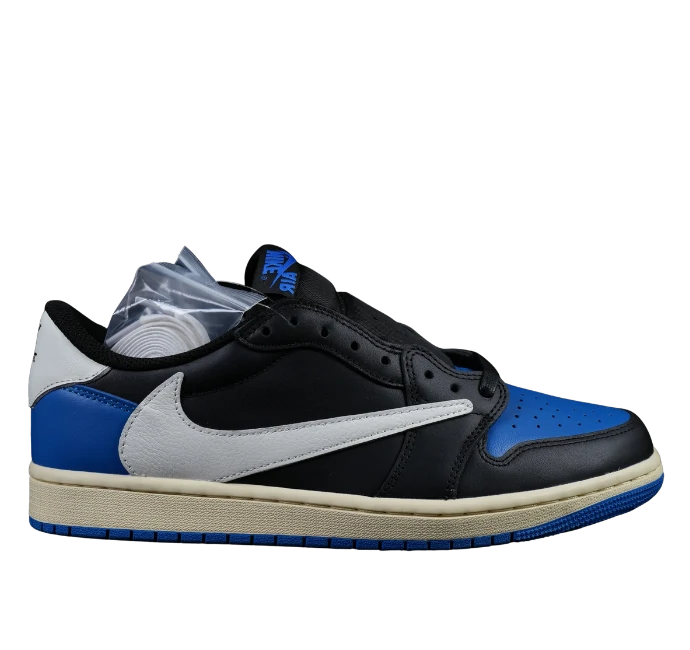
The Retail Price travis scott Jordan 1 Low pairs carried at launch has landed in a narrow band, roughly $130 to $175 depending on the year and the colorway. That sticker is a reference point, not your cost. What a shop actually pays depends on the channel, the volume, the size run, and how long the release has been sitting on the market.
What follows is how that number gets set, where it separates from wholesale and resale, and how to use it when you price a lot or judge a supplier quote. Every figure below is a range for orientation, so confirm the exact number for your colorway before you build a model on it.
How the launch number gets set
Jordan Brand positions the Low OG in the same tier as a standard Air Jordan 1 Low OG, with modest adjustments for packaging and materials. Special boxes, extra lace sets, and premium suede can justify a step up. Seasonal pricing shifts nudge it too, which is why two releases a few years apart rarely match exactly.
Demand plays no part in that figure. A colorway that resells for several times the sticker and one that trades close to it can print the same number on the box. Counterfeiters follow the gap, so the loudest releases need the most scrutiny in your intake process.
Confirm the current figure for the exact colorway before you quote a customer or build a margin sheet. Numbers from two or three seasons back are a rough guide at best, and your sales staff will be the ones explaining the difference at the counter.
Three numbers that get confused
New buyers fold retail, wholesale, and resale into one figure and then wonder why the math falls apart. Each comes from a different party, and only one of the three sits under your control.
| Cost layer | What buyers typically see | Who sets it | Practical takeaway |
|---|---|---|---|
| Retail price | Commonly around $130 to $175 for Low OG releases; confirm per colorway | Brand | Your reference point, not your cost |
| Wholesale quote | Varies widely by volume, channel, and age of the release | Supplier or distributor | Question anything far under retail |
| Resale comps | Market driven; older hyped colorways trade well above launch | Secondary market | Read sold listings, not asking prices |
| Landed cost | Quote plus freight, duty, and payment fees | Carrier and customs | Ask a broker for your duty rate |
A quote that looks strong against resale comps can still lose money once freight, duty, and processing fees land on top. Ask a customs broker for the HTS classification and duty rate on your shipment rather than assuming a percentage from an old invoice.
Note the fourth row. Landed cost is the only figure that tells you what the stock really costs, and it is the one suppliers leave out of a price list most often.
Where the retail figure earns its keep
Treat it as a ceiling on what a customer will accept. Shoppers pull the launch number up on a phone in seconds. Push your shelf price far past it and staff spend the sale defending the difference instead of closing it.
For a stock buyer, the retail price Travis Scott Jordan 1 Low colorways launch at sets two calculations: the room between landed cost and a realistic shelf price, and the risk you carry if the colorway cools while the lot sits in your back room.
Run margin by size, not by lot average. Sizes 9 through 11 turn over quickly in most US shops, while size 7 and size 13 can hang around for months. A low average cost on a broken size run is not a low cost.
There is a negotiation use as well. When a distributor quotes a lot, ask them to price it against the launch figure for that specific colorway. Sellers who work from real release data will answer straight. Sellers working from invented numbers tend to change the subject.
Six checks before you commit to a lot
Most weak buys show their problems before any money moves. An afternoon of verification beats a quarter of dead inventory.
- Match the style code. Get the SKU and release year in writing, then compare them against a public sneaker database or the brand's own product page.
- Read sold listings, not asking prices. Asking figures on the secondary market float well above what buyers actually pay.
- Demand the size breakdown. A headline unit price means little if the run is heavy on sizes your customers never ask for.
- Request landed cost. Freight, duty, and fees should appear as line items, not as a vague note that shipping is included.
- Confirm authentication and returns. Ask who pays return freight on a disputed pair and what proof the supplier accepts.
- Buy one pair first. Sample before volume, even with a supplier you have used for years.
Before you wire a deposit, put the quote next to the retail price Travis Scott Jordan 1 Low buyers see in your own market. If your cost is not meaningfully under that number, the lot only works while resale stays hot, and that is a bet rather than a plan.
Price lists that should slow you down
Supplier quotes arrive with confidence and very little documentation. A few patterns separate the careless from the genuinely risky.
- Pricing well under the retail price Travis Scott Jordan 1 Low colorways command at launch, with no explanation of the channel behind it.
- Identical pricing across every colorway and year, which ignores how the secondary market actually behaves.
- No size breakdown, no style code, and no photos of the units the seller claims to hold.
- Pressure to pay by transfer or payment app with no invoice and no written return terms.
Any single item on that list is a reason to ask questions. Two of them together is a reason to walk, however friendly the seller sounds and however good the unit price looks on the spreadsheet.
Questions buyers ask before ordering
Does the retail price change from colorway to colorway?
Yes, but usually not by much. Most Low OG releases sit within the same tier, and the differences come from materials, packaging, and the season's pricing. Premium suede uppers or a special box can add a step. Confirm the figure per colorway on an official product page or with an authorized stockist before you model margin.
Why does resale run so far above the launch number?
Supply is smaller than demand on the hyped colorways, so secondary prices detach from the sticker almost at release. Older pairs with little deadstock left can drift higher still. Judge the market from sold listings in your actual size range, and remember a slow month can move the number more than any headline does.
Can independent shops buy Travis Scott Jordans at wholesale?
Generally not through the brand's own account program, which is limited and requires approvals most independent shops will not clear. Many buyers source through distributors, liquidation channels, or resale-to-wholesale sellers instead. That route works, but it puts the authentication burden on you, so ask for the channel, the style code, and return terms in writing.
Is US retail pricing the same in other markets?
No. Currency, local taxes, and import costs push regional pricing apart, so a converted figure rarely matches the US number. If you sell in the US, price against US retail and US comps even when your stock came from overseas. Freight and duty belong in your landed cost, not in your shelf price comparison.
Building a Jordan 1 Low order for the next quarter? Send your target size run, shelf price, and delivery window, and our sourcing desk will come back with availability and landed cost ranges. Confirm the colorway, the style code, and the terms in writing before anything ships.